Navigation demo 1
Robot navigation around people in a shared environment.
Featured project · CoRL 2026
Group-Aware Social Navigation for robots that move safely and naturally around people.
Lulu Huang, Wenbo Wang, Guo Cheng, Hao Cheng, Jian-Jian Jiang, Wei-Shi Zheng, and Jingke Meng
Selected demonstrations of group-aware and socially compliant navigation.
Robot navigation around people in a shared environment.
Additional real-world rollout with group-aware behavior.
Visual navigation in a human environment requires more than finding a collision-free path. A robot can avoid a person and still behave intrusively by cutting through the shared space of a conversation or walking between members of a group.
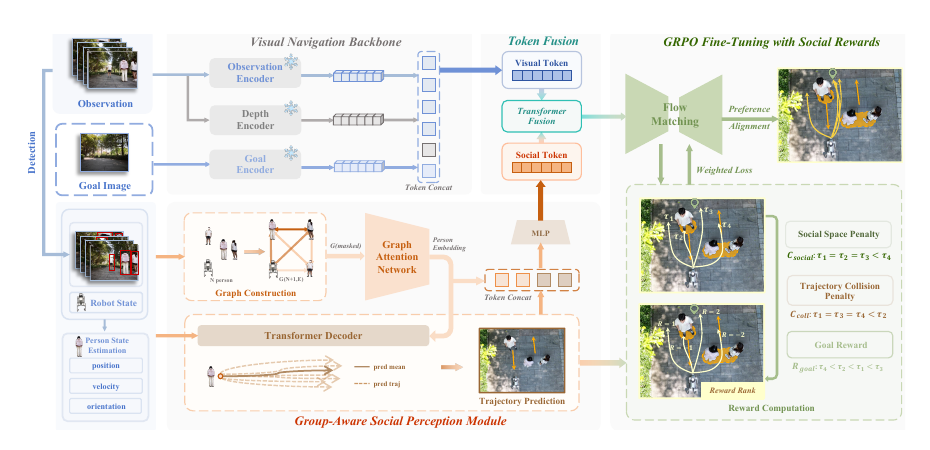
GRACE addresses this problem with a group-aware visual navigation framework. From forward-facing RGB observations and a goal image, it learns to recognize social relationships, anticipate pedestrian motion, and generate trajectories that preserve both personal space and group interaction space.
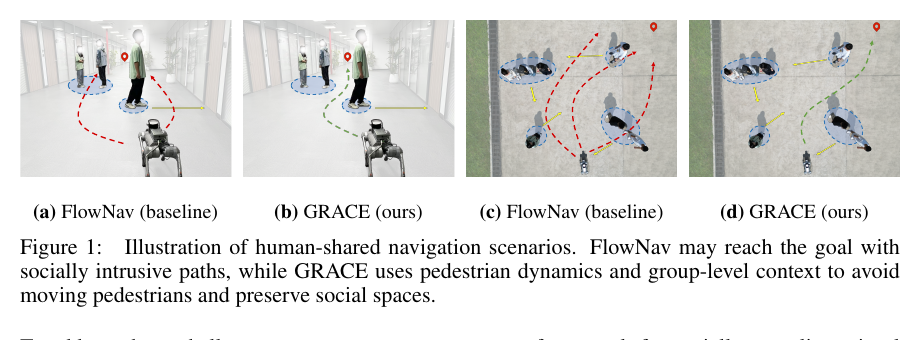
The policy is designed for deployment with RGB input only. It does not require LiDAR, depth sensors, external tracking, or ground-truth group annotations at test time.
Experiments were conducted on a Unitree Go2 quadruped in unseen indoor and outdoor environments. The evaluation covers sparse and dense scenes with both static groups and moving pedestrians. GRACE runs at approximately 15 Hz with around 51 ms end-to-end latency on an external RTX 4060 workstation.
These results show the value of combining explicit group perception, pedestrian prediction, and social reward alignment for navigation around people.