RaFM-Nav demonstration
Risk-aware navigation in cluttered environments.
Risk-aware navigation · IROS 2026
A visual navigation framework that makes flow-matching policies more aware of obstacles, risk, and safe open-space traversal.
Liang Li, Wenbo Wang, Jianjian Jiang, Jingke Meng, and Wei-Shi Zheng
Real-world demonstrations of risk-aware visual navigation.
Risk-aware navigation in cluttered environments.
Risk-aware navigation in an outdoor environment.
Collision-free navigation through a challenging scene.
Indoor real-world experiment with obstacle-aware motion.
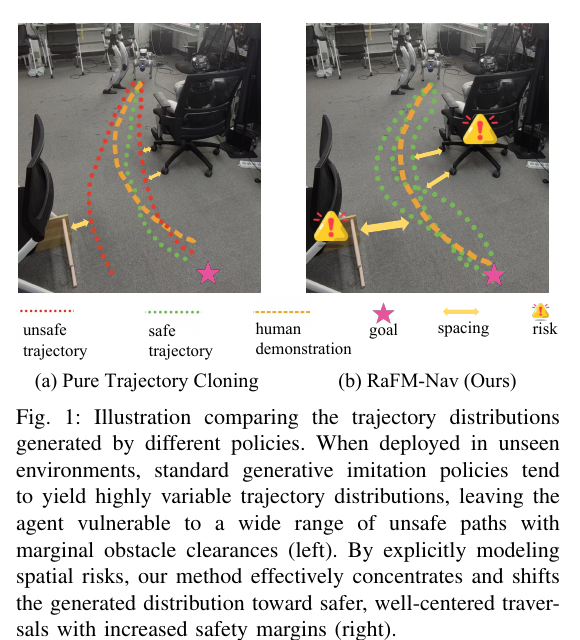
Visual navigation policies learned from human demonstrations can reach goals, but they may still generate unsafe trajectories in cluttered environments. Human demonstrations contain safety cues, yet imitation learning does not always separate those cues from individual preferences and scene-specific conditions.
RaFM-Nav addresses this gap with a risk-aware flow matching framework. It combines explicit obstacle occupancy perception with offline trajectory alignment so that the policy can prefer trajectories with larger clearance and safer open-space routes.
The safety-oriented reward combines an obstacle collision penalty with an open-space incentive. Group-relative weighting then increases the contribution of safer candidates while retaining the original behavior-cloning objective.

RaFM-Nav was evaluated on a Unitree Go2 quadruped across static indoor clutter, unstructured outdoor terrain, and dynamic indoor scenes with sudden pedestrian interference.
These results show that explicit spatial risk perception and offline preference alignment can improve safety while preserving efficient visual navigation.